

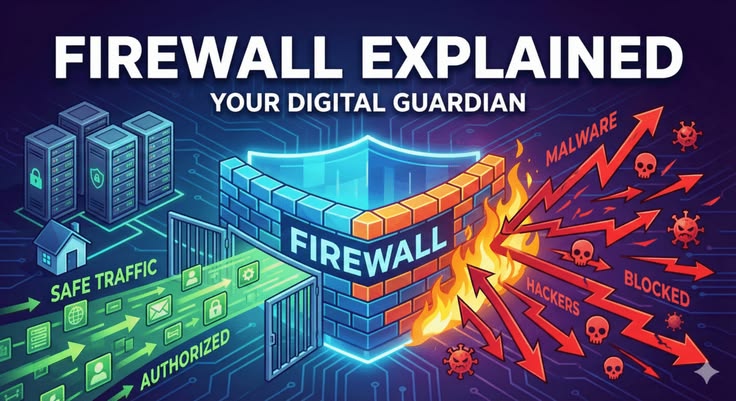
Firewall Security Gap Assessment for UAE Network Protection
A firewall security gap assessment helps UAE businesses find risky rules, unmanaged VPN access, weak segmentation and logging blind spots before attackers or auditors find them.
Rule cleanup
Remove stale, broad or undocumented rules that no longer serve a business purpose.
VPN review
Confirm users, vendors, MFA and access scope for every remote connection.
Evidence pack
Create documentation leadership can use for risk, audit and remediation decisions.
Many firewalls are configured once and then adjusted for years through urgent requests. A supplier needs access. A new application needs a port. A branch needs connectivity. A remote user needs VPN. These changes may be valid, but without review they create accumulated risk.
This guide is different from a firewall architecture guide. It focuses on assessing the current firewall environment, identifying gaps and creating a practical remediation plan connected to cyber security and managed IT services in Dubai.
What a firewall security gap assessment checks
The assessment should begin with rule base analysis. Every rule should have a purpose, owner and risk view. Broad rules, any-any rules, old temporary access and unused objects should be flagged. The review should also check NAT rules, exposed services, administrative access and firmware status.
The second layer is access validation. VPN accounts, vendor tunnels, remote desktop exposure and privileged admin access should be reviewed carefully because they often create direct attack paths into the business.
- Rule base review and risk ranking
- VPN users and vendor access validation
- Public exposure and NAT review
- Admin access and firmware status
- Segmentation between users, servers and backups
- Logging, alerting and retention checks
- Configuration backup and recovery readiness
How to avoid false comfort from firewall ownership
Owning a firewall does not mean the network is protected. Protection depends on how the device is configured, reviewed, monitored and integrated with daily IT operations. If logs are not reviewed, rules are not documented and changes are not approved, the firewall becomes a box rather than a control.
ANSI recommends connecting firewall assessments to server and network solutions, endpoint security, backup strategy and VAPT so weaknesses are addressed across the environment.
Prioritizing remediation after assessment
Not every finding has the same urgency. Publicly exposed administrative services, weak VPN controls, broad internal access to servers and lack of backup isolation should be prioritized quickly. Documentation gaps and cleanup items can follow a scheduled change plan.
If firewall gaps show possible attack paths, a focused VAPT engagement can validate exploitability and help leadership understand impact.
Turning firewall assessment into ongoing governance
A one-time review is useful, but a governance routine is better. Firewall changes should be requested, approved, documented, implemented and reviewed. Old rules should be removed. Vendor access should expire. Logs should have escalation logic. Backup configurations should be stored securely.
This is especially important for businesses with multiple UAE sites, cloud systems, remote employees or regulated customer data. Firewall security must evolve with the business.
| Assessment finding | Why it matters | Priority response |
|---|---|---|
| Old vendor VPN | Supplier access may remain active after project completion. | Disable or restrict until ownership is confirmed. |
| Broad server access | Compromised users may reach critical systems. | Segment by role and business need. |
| Weak logging | Attacks may leave traces that no one reviews. | Enable useful alerts and define escalation. |
| No config backup | Recovery from firewall failure becomes slow. | Store verified configuration backups securely. |
Implementation roadmap for the first 90 days
The safest way to improve this area is to start with a short diagnostic, then move into controlled remediation. During the first 30 days, the business should confirm assets, owners, user access, backup status, exposed services and the highest risk gaps. During the next 30 days, the priority should be fixing confirmed high-risk items, documenting changes and reducing avoidable exposure. By day 90, the company should have a recurring review rhythm with management reporting, assigned owners and evidence of improvement.
This phased approach is important because many SMEs try to solve security by buying another tool. Tools are useful only when they are operated with process, review and accountability. ANSI Technologies focuses on practical execution so the business gets measurable improvement rather than a one-time document that no one uses.
How this supports the wider IT operating model
For UAE businesses that want a single partner across support, security and resilience, ANSI Technologies can align this work with managed IT services, cyber security, VAPT, backup and disaster recovery, cloud solutions, server-network services and data protection planning.
Additional planning considerations
A firewall gap assessment should include interviews, not only configuration review. IT teams can explain why certain rules exist, which vendors still need access and which applications are sensitive to change. This prevents useful rules from being removed blindly while still identifying risky legacy access.
The assessment should also check whether firewall backups and recovery steps are practical. If a firewall fails or configuration is corrupted, the business must know how quickly it can restore service. Configuration backup is often ignored until an outage exposes the gap.
A strong remediation plan should group changes into safe windows. Some rules can be removed quickly, while others need validation with application owners. This staged approach reduces risk while preventing the assessment from becoming another report that sits untouched.
Questions to ask before approval
Firewall gap assessments are also useful before renewal. Before buying a new device or license, the business should understand whether the current problem is capacity, design, configuration, monitoring or governance. This prevents unnecessary spending.
The final assessment report should be practical. It should list quick wins, medium-term design improvements and items that require business approval. This makes the report useful for IT teams and leadership.
Business impact and leadership value
Firewall cleanup also improves support quality. When rules are named clearly and documented properly, new IT engineers can understand the environment faster. That reduces dependency on memory and lowers the risk of accidental changes.
The assessment should become a baseline. After cleanup, future changes can be compared against the approved design, making it easier to keep the firewall clean as the business expands.
For UAE SMEs, firewall gap assessment is often the fastest way to reduce risk without buying a new stack. Many improvements come from cleaning rules, removing old access, enabling useful alerts and documenting ownership. These actions are practical, affordable, visible and useful before a breach occurs.
Firewall security gap assessment gives leadership a realistic view of network exposure. It is not about blaming the previous setup; it is about reducing risk before it becomes an incident.
ANSI Technologies helps UAE companies assess, clean up and manage firewall security as part of cyber security, managed IT, server-network and data protection programs.
Frequently Asked Questions
How often should a firewall assessment be done?
At least annually, and after major office expansion, cloud migration, vendor access changes or security incidents.
Is firewall assessment the same as VAPT?
No. Firewall assessment reviews configuration and governance. VAPT validates whether weaknesses can be exploited.
Can old firewall rules create cyber risk?
Yes. Old or broad rules can expose systems, weaken segmentation and create paths for lateral movement.
Can ANSI Technologies help after the assessment?
Yes. ANSI Technologies can support cleanup, policy redesign, managed monitoring and wider cyber security remediation.
Strengthen your IT, security and resilience roadmap
ANSI Technologies can review your current environment and create a practical improvement plan across managed IT, cyber security, VAPT, backup, cloud, network and data protection.
Cyber Security ServicesServer and Network SolutionsManaged IT Services Dubai