

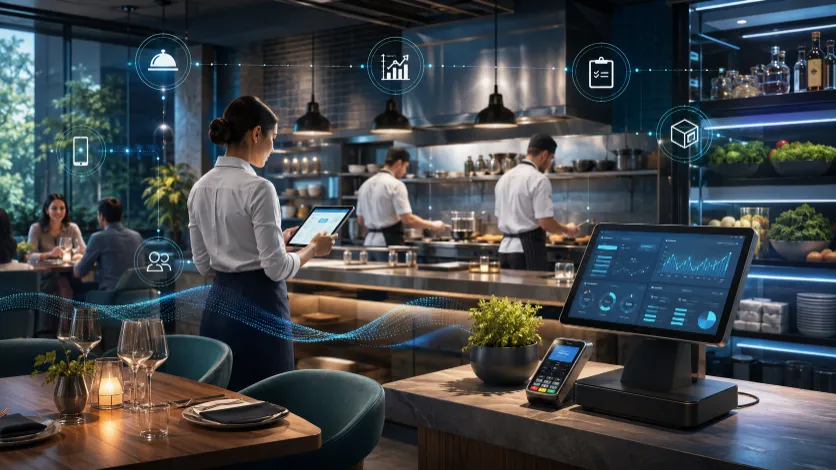
Hospitality & F&B Digital Transformation: ERP, POS, Food Cost, CRM, HRMS, Analytics, Cybersecurity & Customer Journeys
A deep hospitality and F&B guide covering restaurant ERP, POS, recipes, inventory, purchasing, finance, CRM, HRMS, payroll, BI analytics, cybersecurity, OrderMint, QR journeys and managed IT.
What this industry guide is designed to solve
This is not a software-brand comparison. It is a business operating-model guide for leaders evaluating ERP implementation, CRM implementation, finance transformation, HRMS and payroll, BI analytics, cybersecurity, managed IT, cloud, automation and custom application development. The technology stack should follow process complexity, control requirements and measurable business outcomes.
F&B systems should explain outlet profitability every day
Restaurants cannot wait for month-end to discover food-cost or discount leakage. The operating model needs connected POS, purchasing, inventory, recipe/BOM logic, transfers, wastage and finance. A hospitality-capable ERP implementation can suit multi-outlet operations, while a modular ERP model may suit smaller groups. The key control is theoretical versus actual consumption.
POS should connect revenue to inventory and finance
POS handles the guest transaction, but operations need the consequences: product mix, tax, discount, payment, settlement and inventory consumption. OrderMint POS can be evaluated for restaurant, café, bakery and counter environments that need a dedicated POS experience integrated with the wider finance/inventory model.
Purchasing, receiving and recipes determine food cost
Purchase controls should include approved suppliers, order quantity, price variance, receiving and invoice matching. Recipe cost should update when ingredient cost changes. Multi-outlet groups may also need central kitchen, commissary and inter-outlet transfer control. Management needs to distinguish price, yield, portioning and waste causes of food-cost variance.
WhatsApp orders need structure after the conversation starts
Bakeries, catering firms, restaurants and specialty food brands often receive custom or advance orders through WhatsApp. OrderMint can capture customer, order details, payment status, fulfilment, delivery schedule, alerts and team ownership so date, customization and payment details do not remain buried in chat history.
CRM, HRMS and payroll affect repeat business and labor economics
A hospitality CRM implementation can connect customer profile, order/visit history, feedback, service recovery and consent-based retention. A hospitality HRMS implementation should manage outlet, shift, attendance, leave, transfers and payroll inputs. Labor analytics is most useful when viewed with sales and demand rather than as an isolated HR metric.
BI should connect sales mix, food cost, labor and customer behavior
A hospitality BI analytics solution should show daily sales, average check, product mix, discount, theoretical/actual food cost, waste, labor ratio, delivery-channel fees, return/void patterns and customer repeat. Multi-outlet groups need consistent definitions so performance comparisons are meaningful.
Outlet IT, cybersecurity, QR and custom apps are customer-experience controls
An internet outage, POS failure or compromised account is visible immediately to guests. Managed IT services, cybersecurity and backup/recovery should cover connectivity, endpoints, cloud applications and support. GoSmartQR can support menus, Wi-Fi, feedback, reviews, loyalty and offers. Custom apps can support catering quotations, events, central-kitchen planning, franchise reporting or delivery.
Regional operating context: UAE, India and the GCC
Dubai hospitality combines tourism, premium dining, cloud kitchens, cafés and catering; Abu Dhabi includes premium hospitality, corporate/event business and restaurant groups; Sharjah and Ajman have high-volume community and family dining where food-cost and outlet control are decisive. Delhi NCR has huge restaurant, catering and cloud-kitchen activity, Mumbai has dense premium and high-volume food service, and Bengaluru has strong delivery and technology-enabled restaurant ecosystems. Riyadh and Jeddah are major growth markets, with Dammam/Khobar, Doha, Muscat, Kuwait City and Manama adding regional expansion needs.
Relevant ANSI regional capability pages
How ANSI Technologies can assemble the solution without forcing one vendor
The final architecture can combine a fit-for-purpose ERP layer, CRM, HRMS/payroll, BI analytics, cloud and infrastructure, cybersecurity, automation and custom applications. ANSI can evaluate a modular ERP approach, a flexible operations-led ERP approach or an enterprise ERP/CRM architecture, then connect BI analytics, cybersecurity, cloud solutions, managed IT services and business process automation.
Related ANSI digital platforms
Their relevance varies by industry; use them only when they solve a real workflow.
Frequently asked questions
What should restaurant ERP cover?
Purchasing, inventory, recipe/BOM control, transfers, wastage, finance and multi-outlet reporting.
How should POS integrate with ERP?
Product/tax/payment rules should align, sales should feed finance, and inventory should follow the agreed consumption model.
How can restaurants control food cost?
Combine supplier cost, receiving, recipe cost, theoretical consumption, actual stock movement and waste.
Where does WhatsApp order management help?
Custom, catering or delivery orders with changing requirements, payment and fulfilment details.
What should hospitality BI show?
Sales, average check, product mix, discount, food cost, waste, labor, channel fees and outlet contribution.
Build an industry roadmap before buying more software
ANSI Technologies can assess processes, finance controls, customer journeys, workforce systems, analytics, infrastructure and cybersecurity, then define a phased architecture across UAE, India and GCC operations.
Request a technology assessmentExplore managed IT services