


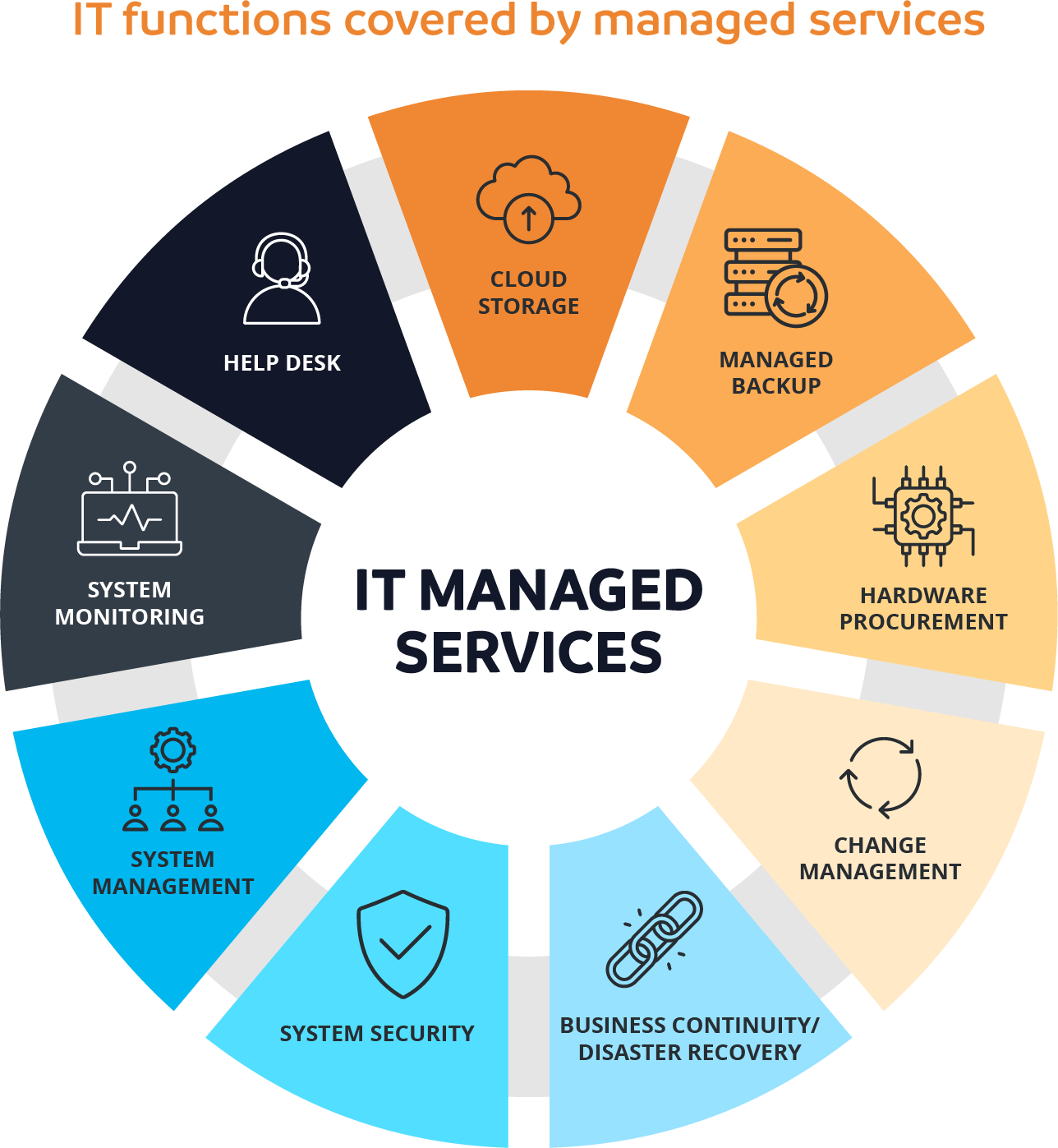
A successful outsourcing arrangement defines what the provider owns, what remains with the business, how remote and onsite support work together, how security and backups are governed, and how service performance is reviewed across every supported UAE location.
Outsourcing should create one accountable operating model
IT outsourcing often fails when the contract lists technologies but does not define ownership. The provider may say an issue belongs to the internet supplier, software vendor or hardware company. Internal employees may assume the provider owns every technology decision. Users do not know where to request help, and management receives several explanations without a single resolution owner.
A stronger model begins with accountability. The provider can coordinate incidents across vendors while the business retains ownership of policy, budget, risk acceptance and strategic priorities. The contract should describe this division clearly enough that users, managers and suppliers know who acts at each stage.
ANSI Technologies provides Managed IT Services for organisations that need structured support, infrastructure oversight, Microsoft 365 administration, security coordination, backup visibility and reporting across UAE operations.
Decide what to outsource and what to retain
Outsourcing does not mean transferring every technology decision to an external company. The business should retain governance and decision rights, while the provider manages agreed operational responsibilities.
| Responsibility | Usually retained by the business | Can be operated by the provider |
|---|---|---|
| Strategy and budget | Business priorities, investment approval and risk acceptance. | Recommendations, technical options and lifecycle forecasts. |
| User support | Business priority and employee conduct decisions. | Service desk, troubleshooting, escalation and user communication. |
| Access | Approval of roles and sensitive permissions. | Account administration, access changes and evidence of completion. |
| Infrastructure | Approval of architecture and major expenditure. | Monitoring, administration, maintenance and vendor coordination. |
| Security | Risk ownership, policy and exception approval. | Operational controls, alert handling, hardening and reporting. |
| Recovery | Business recovery priorities and acceptance. | Backup operations, test coordination and technical recovery procedures. |
Build a service catalogue before comparing providers
A proposal is difficult to compare when every provider interprets “complete IT support” differently. A service catalogue creates a common baseline. It should identify supported users, offices, devices, operating systems, Microsoft 365 services, business applications, internet connections, firewalls, networks, servers, printers and meeting-room equipment.
It should also describe common requests: password resets, account setup, mailbox permissions, laptop preparation, software installation, printer support, connectivity, vendor escalation, device replacement and user offboarding.
Included operations
Routine support, administration, monitoring, maintenance and agreed onsite work.
Separate projects
Major migrations, office moves, new infrastructure, large rollouts and custom integration.
Explicit exclusions
Unsupported legacy systems, third-party development and unapproved equipment or software.
The IT AMC Scope Checklist for Dubai Support Contracts is useful when converting requirements into a comparable scope.
Remote and onsite support should be designed together
Remote support is efficient for account administration, software issues, Microsoft 365, application troubleshooting and many user requests. Onsite support is required for cabling, Wi-Fi, physical hardware, meeting rooms, device replacement and incidents where remote diagnosis is insufficient.
The agreement should state which offices are covered, standard attendance expectations, emergency arrangements, included visits, travel treatment and the process for requesting onsite work. A UAE-wide model may use a central service desk with planned field support in Dubai, Abu Dhabi and Sharjah.
For location-specific coverage, review Managed IT Services Dubai and Managed IT Services Abu Dhabi.
Define service levels in business language
A service-level agreement should not promise that every issue will be resolved within the same fixed time. Resolution may depend on parts, third-party vendors, user availability or complex investigation. The agreement should instead define priority, response, ownership, update frequency and escalation.
| Priority example | Business condition | Expected service behaviour |
|---|---|---|
| Critical | Widespread outage or serious disruption to a business-critical service. | Immediate ownership, continuous coordination and frequent management updates. |
| High | Major user or department affected with limited workaround. | Rapid response, escalation and clear progress communication. |
| Normal | Individual issue with a practical workaround or routine request. | Handled through the standard queue within agreed support hours. |
| Planned | Change, installation or improvement that can be scheduled. | Scope, approval, timing and rollback agreed before execution. |
The IT Support SLA Guide for Dubai Businesses provides a more detailed framework for defining priorities and reporting.
Microsoft 365, identity and endpoint responsibilities
Cloud administration should be included explicitly. The provider may support user creation, licensing, multi-factor authentication, mailbox access, Teams, OneDrive, SharePoint and approved external sharing. Sensitive permissions and administrator roles should follow an approval process.
Endpoint responsibilities should cover inventory, protection status, patching, encryption, software standards and device lifecycle. Employees need to know which devices are supported and how personal or unapproved devices are handled.
For cloud collaboration and user administration, review Microsoft 365 Support. Security controls should be aligned with cybersecurity services.
Infrastructure, connectivity and vendor ownership
The provider should maintain a usable record of internet circuits, firewalls, switches, wireless access points, servers, storage and important vendor contacts. Monitoring and change control should be proportionate to the environment.
When an incident involves several suppliers, the managed provider should remain the coordinating owner until service is restored or the responsibility is formally handed over. This avoids leaving business users to manage telecom, application and hardware vendors independently.
For network, firewall, Wi-Fi, VPN and server requirements, review Server & Network Support.
Security and backup must be written into the scope
An outsourcing agreement that covers user support but ignores security and recovery leaves major operational gaps. The scope should identify who reviews administrator access, endpoint alerts, suspicious email, remote-support tools, backup failures and restoration tests.
Backup responsibilities should specify protected systems, monitoring, retention review, escalation of failed jobs and the schedule for test restores. For design and recovery planning, review backup and disaster recovery.
Plan the transition from the current provider
The transition is a controlled transfer of knowledge and access, not only a contract start date. The incoming provider should receive asset information, administrator access, vendor contacts, diagrams, license details, backup status, open incidents, planned changes and known risks.
- Confirm authority and contacts.
Identify business owners, current suppliers, escalation contacts and approval responsibilities. - Collect and verify access.
Transfer approved credentials securely, remove obsolete accounts and document administrator ownership. - Baseline the environment.
Record users, devices, systems, networks, licenses, backups and outstanding issues. - Stabilise urgent risks.
Address failed backups, unsupported devices, exposed access and unresolved business-critical incidents. - Launch service routines.
Introduce the service desk, priority rules, reporting and scheduled improvement reviews.
Choose the right commercial model
Commercial comparison should distinguish recurring operations from projects, hardware, licenses and specialist work. A low monthly fee may exclude onsite attendance, security administration, backup support or vendor coordination. A higher fee may still be poor value when responsibilities and service evidence are unclear.
Evaluate the number of supported users and locations, service hours, onsite coverage, infrastructure complexity, security responsibilities, backup scope, reporting and required specialist skills. The IT Support Cost Planning for Dubai SMEs guide helps structure these assumptions.
Provider evaluation checklist
- Does the provider define scope, exclusions and project work clearly?
- Is there one accountable service owner and a documented escalation structure?
- How are administrator credentials and remote-support tools protected?
- Can the provider demonstrate a practical onboarding and documentation method?
- How are remote and onsite services coordinated across locations?
- What evidence is provided for backups, monitoring and security actions?
- How are recurring incidents identified and eliminated?
- What management reports and review meetings are included?
- How are third-party vendors managed during incidents?
- How can the agreement scale as users, offices and systems change?
For a broader comparison, review the Managed IT Provider Evaluation Checklist for Dubai Businesses and IT Support Provider Red Flags for Dubai Businesses.
Related Managed IT services and guides
Frequently asked questions
Can an organisation outsource IT support but retain internal IT leadership?
Yes. Internal leadership can retain strategy, budget, risk and business ownership while the provider operates service desk, infrastructure, administration, monitoring and specialist escalation.
Should onsite support be included in the monthly agreement?
The agreement should state included visits, covered locations, response expectations and additional charges. The right model depends on the number of offices and physical infrastructure.
How should third-party vendor issues be handled?
The managed provider should coordinate the incident and remain accountable for communication until the responsible supplier resolves the issue or ownership is formally transferred.
What is the most important part of provider transition?
Verified access, current documentation, open-issue ownership, backup status and clear communication are essential. A rushed transition creates hidden risk.
Create one accountable support model across UAE operations
ANSI Technologies can assess the current environment, define the service catalogue, document responsibilities, stabilise risks and operate managed IT support across Dubai, Abu Dhabi, Sharjah and other agreed locations.
Managed IT Services