

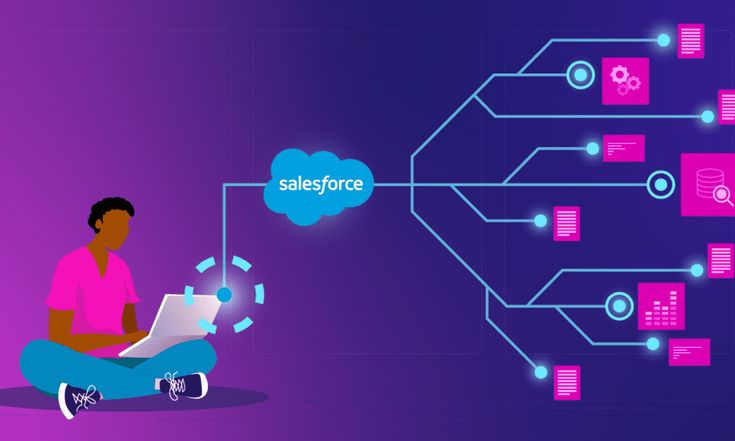
Salesforce Integration Services in UAE: Connecting CRM with ERP, Finance and Web Leads
Salesforce delivers real business value when it becomes part of a connected operating model. Sales teams need clean leads, finance needs reliable order and invoice visibility, management needs accurate dashboards, and service teams need customer history without switching between disconnected tools.
Connected revenue data
Bring website leads, campaigns, opportunities, quotations and customer records into one controlled CRM flow.
Operational visibility
Connect Salesforce with ERP, finance, support and reporting systems so teams do not work from different versions of data.
Governed integrations
Design sync rules, ownership, exception handling and monitoring so integrations remain reliable after go-live.
Many UAE businesses start with Salesforce as a CRM implementation project. The next challenge is integration. Leads may arrive from a website, campaigns may run in a separate platform, finance may use an ERP or accounting system, and customer service may operate through a ticketing tool. If these systems are not connected properly, users lose trust in CRM and leadership loses visibility.
ANSI Technologies helps companies plan and deliver Salesforce integrations with a practical business-first approach. The goal is not to connect every possible system on day one. The goal is to identify the systems that affect revenue, service quality, reporting and operational control, then connect them in a secure and maintainable way.
Where Salesforce integration creates the most value
Integration should begin with business impact. For most companies, the highest value areas are lead capture, customer master data, quotation and order flow, finance visibility, support history and management reporting. These areas directly affect sales productivity, customer experience and decision making.
| Integration area | Business outcome | Typical systems |
|---|---|---|
| Website and landing page leads | Faster lead capture, source tracking and assignment to sales teams | Corporate website, campaign pages, forms and chat tools |
| ERP and finance | Cleaner customer records, order visibility, invoice status and account control | ERP, accounting, billing and inventory systems |
| Marketing platforms | Better campaign attribution and follow-up management | Email marketing, automation tools and event platforms |
| Support and service tools | Complete customer view across sales, delivery and service | Helpdesk, ticketing, field service and service desk platforms |
| BI and reporting | Management dashboards based on trusted CRM and operational data | Analytics tools, data warehouse and reporting platforms |
Integration design should define ownership first
A common mistake is starting integration with API fields before deciding data ownership. If Salesforce and ERP both store customers, which system owns the legal customer name? If both systems store products, which system owns item codes and pricing? If invoices are created in finance, should Salesforce display invoice status or create the invoice directly?
These decisions matter because they prevent duplicates, broken reports and user confusion. A practical integration blueprint should define the system of record, field ownership, sync direction, sync frequency, exception handling and audit requirements. Without this clarity, integration can create more confusion than manual work.
Salesforce integration blueprint
- Confirm the systems that must connect in phase one and phase two.
- Map master data ownership for customers, contacts, products, price lists and users.
- Define which records move from Salesforce to ERP and which records move back to Salesforce.
- Document field mapping, mandatory fields, validation rules and error handling.
- Plan security, API access, logging, monitoring and administrator ownership.
- Test real business scenarios before go-live, not only sample technical transactions.
ERP and finance integration
For many businesses, the most important integration is between Salesforce and ERP or finance. Sales teams need to know whether a customer has active invoices, credit limits, order history or pending deliveries. Finance teams need reliable customer and deal data without retyping information. Management needs a view of pipeline, booked revenue and actual billing.
The design should be simple enough to maintain. In many cases, Salesforce should manage leads, accounts, opportunities and customer engagement, while ERP or finance systems manage stock, invoices, payments, taxes and accounting records. The integration layer can then exchange only the data needed for business visibility and process control.
Web lead and campaign integration
Website and campaign leads are often lost because forms are emailed to a shared inbox or downloaded manually. A stronger model sends enquiries into Salesforce with source, campaign, service interest, location, consent, assignment rules and follow-up status. This helps sales managers understand which campaigns create qualified conversations and which channels only create noise.
For companies investing in digital marketing, Salesforce integration with web forms, landing pages and marketing tools can improve response speed and attribution. The CRM should show where the enquiry came from, what the customer requested and what happened after assignment.
APIs, middleware and connectors
Not every integration requires heavy custom development. Some systems have ready connectors. Others require API-based integration or middleware. The right method depends on transaction volume, complexity, security, budget, exception handling and long-term maintainability. A small business may start with a controlled connector. A larger business may need middleware, scheduled syncs, error queues and monitoring dashboards.
ANSI Technologies can help evaluate whether a connector, API integration, middleware flow or custom service is the right path. The decision should be based on reliability and supportability, not only initial cost.
Security and governance
Salesforce integrations carry sensitive business data. API users should have limited permissions. Credentials should be stored securely. Logs should be reviewed. Failed syncs should generate alerts. Administrator roles should be controlled. If external systems push data into Salesforce, validation rules and duplicate controls should be tested carefully.
A good integration is not only technically connected. It is monitored, documented and owned. The business should know who receives alerts, who resolves data issues and who approves changes when fields or workflows are modified.
Testing and cutover planning
Integration testing should use real business examples. A test plan should include new lead creation, customer updates, quotation movement, order status updates, invoice visibility, failed transaction handling and duplicate prevention. Technical success is not enough if sales, finance and operations users cannot trust the result.
Cutover should also be planned carefully. The business should decide whether data will be migrated once, synchronized in stages or connected only from a specific go-live date. A clear cutover plan reduces confusion when users begin relying on integrated data for daily decisions.
Reporting after integration
Connected data should improve management reporting. After integration, leadership can review lead source performance, pipeline movement, order conversion, pending invoices, customer value and service issues with better context. This is where integration becomes a business improvement project rather than a technical connector task.
Operational ownership after launch
After launch, the business should assign owners for field changes, access requests, sync failures and reporting adjustments. This avoids the common situation where every issue is treated as a new project. A clear ownership model keeps the integration stable and gives users confidence that problems will be resolved quickly.
For larger environments, ownership can include a business owner, Salesforce administrator, integration owner and finance or operations reviewer. This keeps change requests practical and prevents uncontrolled changes from damaging important reports.
How ANSI Technologies supports Salesforce integration
ANSI Technologies supports Salesforce integration planning, API design, connector evaluation, data flow mapping, dashboard alignment and post-launch monitoring. The integration service is closely connected with Salesforce integration services, Salesforce implementation, Salesforce development and broader Salesforce consulting services.
Need Salesforce connected with ERP, finance or web leads?
ANSI Technologies can review your current Salesforce environment, identify the right integration priorities and create a phased plan that protects data quality and business continuity.
Explore Salesforce integrationReview Salesforce implementation
Frequently asked questions
Can Salesforce integrate with ERP and finance systems?
Yes. Salesforce can integrate with ERP and finance systems through APIs, middleware, connectors or custom integration services. The best method depends on data ownership, transaction volume and business process design.
What data should sync between Salesforce and ERP?
Common sync areas include customer records, contacts, products, opportunities, orders, invoice status, payment status and support data. The final scope should be based on business impact and data ownership.
How do we avoid duplicate customer data?
Duplicate risk is reduced by defining the system of record, matching rules, mandatory fields, validation rules and exception handling before integration is launched.
Should integration happen during or after Salesforce implementation?
Critical integrations should be planned during implementation, even if they are delivered in phases. Waiting until after go-live can create rework if field design and process ownership were not considered.
Can ANSI Technologies support custom Salesforce API work?
Yes. ANSI Technologies can support API planning, custom development, connector review, middleware design, testing and monitoring for Salesforce integration scenarios.