
Growth creates a strange problem for many businesses.
At the beginning, a spreadsheet is enough.
A few customer details live in Excel. Sales conversations happen through email. Finance maintains another spreadsheet. Employees submit requests through messages. Project updates happen in meetings. Customer support keeps its own records.
It works — until the business grows.
Suddenly, the same customer exists in multiple systems. Sales doesn’t always know whether an invoice has been paid. Finance doesn’t have complete visibility into customer activity. Managers wait for reports. Employees repeat the same data entry.
The problem isn’t necessarily a lack of software.
The problem is disconnected processes.
This is where a well-designed Zoho ecosystem can make a meaningful difference.
ANSI Technologies helps businesses design connected Zoho workflows that bring customer management, finance, HR, projects, automation and support closer together — while keeping the implementation aligned with how the business actually operates.
Zoho itself provides applications covering areas such as sales, finance, HR, support, collaboration and analytics, and Zoho recommends approaching adoption based on the organization’s priorities rather than attempting to configure everything at once.
Why Businesses Outgrow Disconnected Software
Most companies don’t intentionally create complicated technology environments.
They simply add tools as new requirements appear.
A sales team needs CRM software.
Finance needs accounting software.
HR needs employee management.
Operations needs project tracking.
Customer service needs ticketing.
Management wants dashboards.
Eventually, employees spend more time moving information between systems than actually using it.
Common symptoms include:
- Duplicate customer records
- Manual data entry
- Repeated spreadsheet updates
- Delayed approvals
- Missed follow-ups
- Unclear sales pipelines
- Slow invoice processing
- Limited management visibility
- Disconnected customer support
- Difficulty tracking projects
- Poor user adoption
These issues can become particularly expensive as organizations scale.
The answer isn’t always to purchase another application.
Sometimes the better approach is to connect the applications and redesign the workflow.
What Is Zoho Business Process Automation?
Zoho business process automation involves using Zoho applications, workflows, integrations, and business rules to reduce repetitive manual activity.
Instead of employees repeatedly moving information from one system to another, connected workflows can help information move between business functions.
For example:
Lead → Qualification → Deal → Quote → Invoice → Payment → Customer Support
Rather than treating each stage as a separate activity, businesses can design a connected process.
This is one reason Zoho CRM, Zoho Books, and other applications can work together. Zoho’s documentation describes integrations between CRM and Books that can synchronize customer and transaction information and support automated actions such as creating invoices after a deal is won.
The objective isn’t simply automation.
The objective is process continuity.
The Five Layers of a Smarter Zoho Ecosystem
A successful Zoho environment usually has several layers working together.
1. Customer and Sales Management
Zoho CRM can become the central location for:
- Leads
- Contacts
- Accounts
- Deals
- Sales activities
- Follow-ups
- Pipeline stages
- Sales reports
- Customer interactions
But CRM implementation should reflect the company’s actual sales process.
A construction company, technology company, real estate company and professional-services firm may all require different pipelines.
That is why configuration should begin with the business process rather than a generic CRM template.
ANSI Technologies provides Zoho CRM consulting and implementation services for businesses that need structured sales workflows, automation and visibility.
2. Finance and Revenue Operations
Sales doesn’t end when a deal is closed.
The next questions are:
- Was a quotation approved?
- Was an invoice generated?
- Has payment been received?
- Is the customer overdue?
- What is the customer’s financial history?
Connecting CRM and finance processes can reduce repetitive data entry and improve visibility between departments.
ANSI Technologies provides Zoho Books consulting and implementation for businesses looking to improve invoicing, finance workflows, reporting and sales-to-finance coordination.
3. HR and Employee Workflows
Business automation shouldn’t stop with customers.
Internal processes can also be streamlined.
Examples include:
- Employee onboarding
- Leave requests
- Attendance
- Employee records
- Approval workflows
- HR documentation
- Performance processes
ANSI Technologies provides Zoho HRMS solutions to help organizations digitize employee-related processes and create better operational visibility.
4. Projects and Delivery
For businesses delivering projects or professional services, sales visibility alone isn’t enough.
Once a deal becomes a project, teams need to know:
- Who owns the project?
- What tasks are pending?
- How much time has been spent?
- What deadlines are approaching?
- What is the customer’s project status?
ANSI Technologies provides Zoho Projects implementation services to help businesses organize project planning, collaboration, task management and delivery workflows.
5. Customer Support
The customer journey doesn’t stop after the sale.
Support requests, service issues, and customer communication also need visibility.
A connected support process can help organizations manage:
- Customer tickets
- Service requests
- Escalations
- SLAs
- Support ownership
- Resolution tracking
- Customer history
ANSI Technologies also provides Zoho Customer Support solutions for businesses that want stronger customer-service workflows.
Why Zoho One Can Make Sense for Growing Businesses
Some organizations don’t need a complete ecosystem immediately.
Others have already reached the point where multiple departments need to work from connected information.
For those businesses, Zoho One can provide a broader platform approach.
Zoho describes Zoho One as a suite covering areas such as sales, marketing, finance, HR, support, collaboration and analytics.
The important point is not to activate every application simply because it exists.
A better approach is:
Business requirement → Process → Application → Configuration → Automation → Adoption
ANSI Technologies provides Zoho One implementation services for businesses that want to create a connected Zoho environment across multiple departments.
Automation Should Solve a Problem — Not Create More Complexity
Automation is powerful, but poorly designed automation can make a business harder to manage.
For example, creating dozens of workflows without clear ownership can produce:
- Unexpected notifications
- Conflicting rules
- Duplicate records
- Confusing approvals
- Difficult troubleshooting
A better approach is to identify high-value repetitive processes first.
For example:
Before automation
Salesperson receives lead → manually creates record → sends email → updates spreadsheet → informs manager → waits for approval.
After automation
Lead captured → CRM record created → assignment triggered → follow-up task generated → notification sent → management dashboard updated.
The difference isn’t simply fewer clicks.
It is better process consistency.
ANSI Technologies provides Zoho Automation services for workflow automation, approvals, alerts, escalations and connected business processes.
Customization: When Standard Configuration Isn’t Enough
Every business has unique requirements.
Sometimes standard Zoho functionality is sufficient.
Sometimes businesses need:
- Custom modules
- Custom forms
- Specialized approval logic
- Portals
- Custom dashboards
- API integrations
- Deluge-based business logic
- Third-party integrations
- Industry-specific workflows
That is where customization can become valuable.
ANSI Technologies provides Zoho Customization services to extend Zoho around specific business requirements instead of forcing employees into an unsuitable process.
What About ERP?
For organizations managing inventory, purchasing, orders, operations and other business processes, CRM alone may not provide sufficient operational coverage.
A broader ERP-oriented approach can connect operational workflows with sales and finance.
ANSI Technologies provides Zoho ERP consulting and implementation for businesses that need stronger operational control and connected workflows.
Why Implementation Matters More Than Software Selection
Choosing Zoho is only the beginning.
The more important questions are:
What should be implemented first?
Which data should be migrated?
Which processes should be automated?
Which users need access?
Which approvals should exist?
Which reports does management actually need?
Which applications need to communicate with one another?
These decisions determine whether a business ends up with a useful operating system — or simply another collection of software screens.
ANSI Technologies approaches Zoho projects around business discovery, solution design, configuration, customization, integration, automation, migration, training and post-go-live support. The company’s main Zoho services page similarly emphasizes process-first architecture, phased rollout and ongoing optimization.
A Practical Zoho Roadmap for Growing Businesses
A sensible rollout can look like this:
Phase 1 — Discover
Document existing processes.
Phase 2 — Prioritize
Identify the processes causing the greatest operational friction.
Phase 3 — Design
Choose the right Zoho applications and define how they should interact.
Phase 4 — Configure
Set up fields, layouts, permissions, workflows and dashboards.
Phase 5 — Integrate
Connect relevant business applications.
Phase 6 — Automate
Remove repetitive manual activities.
Phase 7 — Migrate
Move clean, relevant data into the new environment.
Phase 8 — Test
Use real business scenarios rather than theoretical demonstrations.
Phase 9 — Train
Train employees according to their roles.
Phase 10 — Optimize
Review adoption, reports, workflows and business requirements after launch.
This phased approach also aligns with Zoho’s own guidance that organizations can start with a priority area and expand gradually rather than configuring everything simultaneously.
Choosing a Zoho Implementation Partner
Businesses evaluating Zoho consultants should look beyond the number of applications a provider claims to know.
Ask:
Can they understand our business process?
Software configuration without process understanding can create unnecessary complexity.
Can they integrate systems?
CRM, finance, HR, projects, and support often need to communicate.
Can they customize?
Some businesses require specialized workflows beyond standard configuration.
Can they handle migration?
Poor-quality data can damage a new system before it even launches.
Do they provide training?
User adoption determines whether the implementation becomes part of everyday operations.
Is support available after go-live?
Business requirements change. Workflows need refinement.
Can they scale with us?
The right implementation should support the business today without creating unnecessary limitations tomorrow.
ANSI Technologies: From Zoho Setup to Connected Business Operations
ANSI Technologies takes a broader approach to Zoho.
Rather than treating CRM, ERP, HRMS, Books, Projects, automation, and customization as isolated services, the objective is to understand how those functions connect.
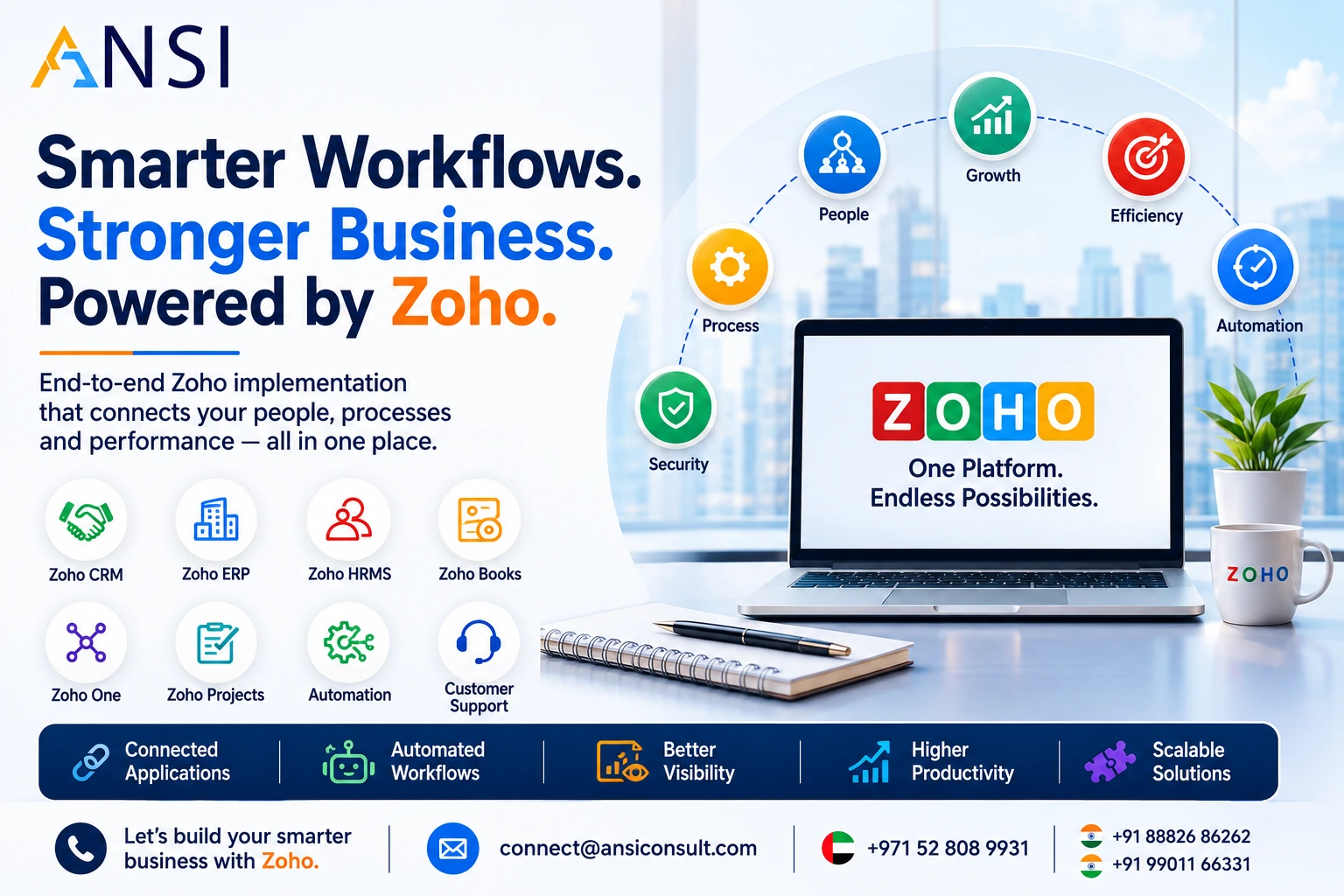
The wider Zoho portfolio includes:
- Zoho ERP
- Zoho CRM
- Zoho One
- Zoho HRMS
- Zoho Books
- Zoho Projects
- Zoho Implementation
- Zoho Customization
- Zoho Automation
- Zoho Customer Support
The aim is simple:
Less disconnected work.
Better visibility.
More automation.
Stronger adoption.
A business system that can grow with the organization.
Looking for Zoho Implementation Support?
If your business is evaluating Zoho, replacing disconnected tools, or trying to improve an existing Zoho environment, ANSI Technologies can help you determine the right implementation path.
For businesses specifically evaluating implementation support in Vancouver, see the dedicated Zoho Implementation Partner in Vancouver, Canada.