

Zoho implementation in Delhi NCR for businesses that need sales, finance and operations alignment
Delhi NCR businesses often operate across sales offices, factories, warehouses, service teams and finance desks. The pressure is not just lead management; it is the handover from enquiry to quotation, order, delivery, invoice, collection and repeat customer engagement.
Zoho can support this when Zoho ERP planning, CRM and finance are treated as one connected operating model. ANSI Technologies designs the rollout around practical Indian business workflows rather than generic CRM configuration.
Delhi NCR needs CRM that respects operational reality
Manufacturing, trading and service companies in Delhi NCR often have quotation dependencies: stock availability, vendor price, delivery date, technical validation or management approval. A CRM that only tracks lead status will not be enough.
Zoho CRM implementation should capture requirement details, stage evidence, quotation status, follow-up ownership and closure probability. The design should help sales users work faster while giving management a reliable view.
Finance handover must be accurate
Indian businesses need clean customer data, GST-related information where applicable, billing addresses, item details, payment terms and approval status. If this data is missing at closure, finance delays the invoice and sales teams continue chasing internally.
Connecting CRM with Zoho Books can improve invoice preparation, receivable tracking and financial visibility. The integration should be controlled so only qualified customer records move into finance.
HR and attendance can be added when the team grows
Delhi NCR companies with field teams, office staff or factory employees may also need leave, attendance, employee records and approvals. Zoho HRMS can be introduced when HR process maturity becomes part of the same digital roadmap.
The advantage of Zoho is that HR, sales, finance and projects can be connected gradually. The business does not need to force every module into phase one.
Dashboards should show leakage
Management needs visibility into lost leads, delayed quotations, pending approvals, overdue collections, inactive accounts and sales team performance. These reports should be actionable. A report that does not change a decision should not dominate the dashboard.
ANSI Technologies normally recommends weekly review dashboards during the first months after go-live so users see that management is serious about data quality.
Implementation with adoption discipline
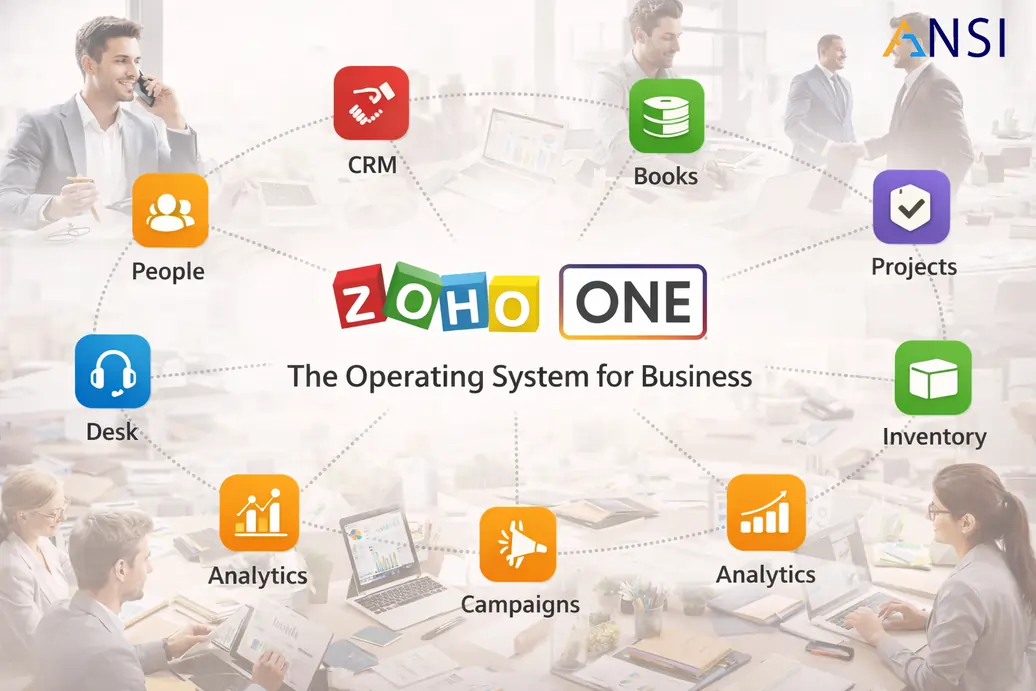
If the scope includes broader operations, Zoho One implementation can provide additional apps for projects, support, campaigns and analytics. ANSI Technologies sequences these tools so users are not overwhelmed.
A strong Delhi NCR Zoho rollout should reduce manual follow-up, improve customer history, speed up finance handover and give leadership better visibility.
What the Delhi NCR team should prove before Zoho goes live
To make this article useful rather than thin location content, the implementation plan should include concrete working scenarios. For Delhi NCR, the important areas are Delhi NCR sales, finance control, operations workflow, GST-ready handover. The team should not approve the setup only because screens look complete; it should approve the setup because actual users can complete real transactions, read the reports and understand the exceptions.
For this Zoho page, a strong test pack would include the following working examples. Each one should be performed by the person who will own it after launch, observed by the implementation team and signed off only when the result is clear to sales, operations, finance or management as applicable.
- A delhi ncr enquiry needs technical validation before quotation.
- A customer record carries gst-ready billing data before finance handover.
- A manufacturing lead requires stock, delivery date and approval context.
- A trading opportunity is reviewed for margin before the quote is sent.
- A sales manager sees delayed follow-up by product line and owner.
- A zoho books invoice is prepared without retyping customer information.
- An hr approval is added only after the core sales-finance flow is stable.
- A weekly dashboard reveals quotation leakage and collection exposure.
The data preparation behind these examples is equally important. The business should verify customer names, contact records, product or service definitions, user roles, approval limits and reporting dimensions before migration. If master data is weak, even the best workflow will produce reports that users question.
Integration decisions should also be conservative in the first release. A connected platform is valuable, but every sync creates dependency. The team should decide which records move automatically, which records require approval, which fields remain read-only and which exceptions are handled manually until the process matures.
Go-live should be treated as a controlled cutover, not only a date on the calendar. Open transactions, active enquiries, pending invoices, warehouse quantities, project tasks or employee approvals should be reconciled so users know what belongs in the new system and what remains historical reference.
After launch, the first thirty days should be used to watch behavior. If users avoid a field, ignore an alert or export reports to spreadsheets, that is a signal to review the design. The right response is not always more automation; sometimes the fix is better naming, better training or a simpler approval rule.
The most useful management review is practical: what is overdue, what is blocked, which customer needs action, which transaction is waiting for approval and which report cannot yet be trusted. When leadership uses these answers every week, the platform becomes part of the business rhythm.
From a business perspective, these scenarios protect the rollout from becoming a cosmetic setup. They show whether Zoho can support the way Delhi NCR teams sell, buy, deliver, approve, invoice, report and improve. If a scenario cannot be completed calmly during testing, it should not be hidden until go-live.
What to include now and what to hold for the next phase
The safest scope is the one that reflects real working pressure. If the team struggles with follow-up, stock visibility, billing readiness, project handover or approval delays, those issues should shape the first phase more than a generic feature list.
The scope should be written in working language. Instead of only listing CRM, finance, HR, projects, support and analytics modules, the plan should describe exactly how lead capture, account records, opportunity stages, finance handover, approval rules and weekly management dashboards will improve. This gives users a business reason to enter accurate data.
Every item removed from phase one should have a reason and a future decision point. This prevents scope from drifting while reassuring stakeholders that important enhancements have not been forgotten.
Ownership should continue after go-live. Someone must decide when a field is added, when an automation is changed, when a duplicate is merged and when a report becomes official.
A strong risk review does not slow the project; it prevents rework. The implementation team should know which workflows are most sensitive and which reports management cannot afford to mistrust.
Governance should be light but real. For this rollout, governance means field governance, role permissions, duplicate prevention and controlled sync rules between apps. It should prevent disorder without making daily work bureaucratic.
A generic training session is rarely enough. Users should practice the transactions they will perform after launch, including mistakes, corrections and approval delays.
Leaders should avoid demanding perfect dashboards on day one. The first month is about improving behavior, fixing weak spots and proving that the operating platform can support real decisions.
When this discipline is followed, Zoho becomes more than a software subscription. It becomes a management system that supports accountability across the business.
A final readiness review should compare the new process with the old process. If the new Zoho flow does not remove a real delay, reduce a known error or improve a decision, the configuration should be simplified or moved to a later phase.
That final review also gives the internal team a simple reference point after go-live, so future improvements are based on observed work rather than fresh guesswork.
Practical checks before go-live
FAQs
Is Zoho suitable for Delhi NCR manufacturing and trading companies?
Yes. Zoho can support CRM, finance, inventory-adjacent workflows, HRMS, projects and reporting depending on the selected apps and implementation design.
Can Zoho handle GST-related billing data?
Zoho Books can support Indian finance requirements, but customer and item data should be captured correctly before finance handover.
Should CRM and Books be implemented together?
For many businesses, yes. Sales and finance handover is a major control point, so implementing both together can improve visibility.
Can Zoho support approval workflows?
Yes. Approvals can be configured for discounts, quotations, finance handover, leave, expenses or other business controls.
How can Zoho help Delhi NCR sales teams?
Zoho can track enquiries, accounts, activities, quotations, follow-ups, deal stages and dashboards so managers see sales movement more clearly.
Is Zoho One required?
Zoho One is useful when multiple apps are needed. If the current requirement is only CRM or Books, a smaller app scope may be enough.
Can ANSI Technologies migrate existing data?
Yes. Data migration can be planned after cleaning customers, contacts, products, users and open transactions.
What should be avoided during implementation?
Avoid importing messy data, creating too many stages, automating unclear processes and launching too many apps before users are trained.
Plan the rollout with fewer surprises
ANSI Technologies can review your current process, data quality, app scope, integrations and reporting expectations before configuration begins. To avoid a copy-paste software rollout, discuss a Zoho implementation roadmap with a process-led implementation team.